


Registers And RAM: Crash Course Computer Science #6
Registers And RAM: Crash Course Computer Science #6 Ram is like a human's short term or working memory, where you keep track of things going on right now like whether or not you had lunch or paid your phone bill. Registers and ram: crash course computer science #6 crashcourse • 2.1m views • 7 years ago.

Registers And RAM: Crash Course Computer Science #6 Instructional Video ...
Registers And RAM: Crash Course Computer Science #6 Instructional Video ... Today we’re going to create memory! using the basic logic gates we discussed in episode 3, we can build a circuit that stores a single bit of information, and then through some clever scaling (and of course many new levels of abstraction) we’ll show you how we can construct the modern random access memory, or ram, found in our computers today. Tl;dr this video explains how computer memory works, starting from a single bit storage circuit and scaling up to the use of matrices to create larger memory modules. 1. what is the difference between registers and ram? ans. registers and ram are both types of computer memory, but they serve different purposes. registers are small, high speed memory units located within the cpu. they store instructions and data that the cpu needs to access quickly. Early computers had 8 bit registers, then 16, 32, and today, many computers have registers that are 64 bits wide. to write to our register, we first have to enable all of the latches. we can.

Crash Course Computer Science #6: Registers And Ram Instructional Video ...
Crash Course Computer Science #6: Registers And Ram Instructional Video ... 1. what is the difference between registers and ram? ans. registers and ram are both types of computer memory, but they serve different purposes. registers are small, high speed memory units located within the cpu. they store instructions and data that the cpu needs to access quickly. Early computers had 8 bit registers, then 16, 32, and today, many computers have registers that are 64 bits wide. to write to our register, we first have to enable all of the latches. we can. Using the basic logic gates we discussed in episode 3 we can build a circuit that stores a single bit of information, and then through some clever scaling (and of course many new levels of abstraction) we’ll show you how we can construct the modern random access memory, or ram, found in our computers today. Using the basic logic gates we discussed in episode 3 we can build a circuit that stores a single bit of information, and then through some clever scaling (and of course many new levels of abstraction) we’ll show you how we can construct the modern random access memory, or ram, found. Study with quizlet and memorize flashcards containing terms like ram, and or latch, the action of putting data into memory is called . and more. Video: registers and ram: crash course computer science #6 | watch crash course computer science online | pbs video.
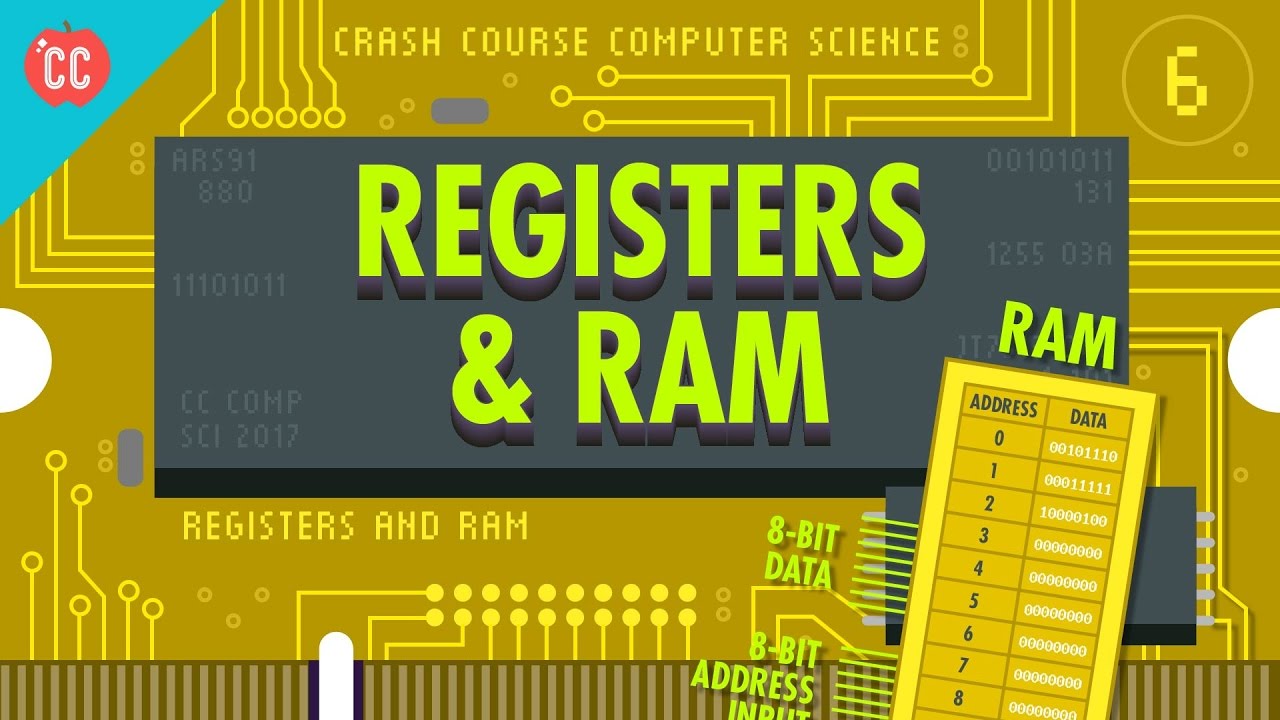
Registers and RAM: Crash Course Computer Science #6
Registers and RAM: Crash Course Computer Science #6
Related image with registers and ram crash course computer science 6


Related image with registers and ram crash course computer science 6


About "Registers And Ram Crash Course Computer Science 6"
Comments are closed.